Steve Holmes
Cholangiocarcinoma Survivor
25-Hour Surgery Across Three Operations, Rapid Progression to Stage 4 & Complete Immunotherapy Response (KEYNOTE-158)
Listen: 14:55 Minutes:
The Deep Dive Podcast with hosts Rivi and Todd, capturing Steve and Claire’s Story from a different angle.
The written version below expands their conversation, providing additional detail and reflection on what unfolded.
Seeing The Minuscule Differences.
Steve Holmes is a stage 4 cholangiocarcinoma survivor whose journey through surgery, recurrence and immunotherapy reveals the biology and decisions behind survival.
In aggressive diseases like cholangiocarcinoma, survival often sits inside very narrow spaces. What appears impossible at first glance may simply be unlikely. The difference can be minuscule. But when life is on the line, that difference matters.
Steve and Claire understood this very early.
His role as the patient was to recognise the difference between the unlikely and the impossible. That responsibility was his to carry. Taking that responsibility also elevated Claire’s capacity to help. A clarity often underestimated, but remarkably effective.
A Deep Dive into Steve Holmes’ Cholangiocarcinoma Survival
Cholangiocarcinoma, or bile duct cancer, is one of the most aggressive cancers in medicine. When diagnosed at any stage, long-term survival has historically been considered extraordinarily low. Yet Steve had to survive a rapid onset of metastatic cholangiocarcinoma long enough for science to catch up.
His story is not only about medicine. It is also about the architecture of thinking required to stay alive when the odds appear impossible.
A Medical Reality Measured in Statistics
Cholangiocarcinoma, often referred to as bile duct cancer, is widely recognised as one of the most aggressive cancers in medicine. Bile ducts originate from deep in the liver, and cholangiocarcinomas are frequently spoken about alongside pancreatic cancer because of their biology and the difficulty of detecting them early.
When the disease has already spread beyond the bile ducts, survival has historically been extremely low, especially if distally located. For metastatic cases, the outlook has long been measured in months rather than years.
That was the reality Steve Holmes faced.
Controlling the One Thing Still Within Reach
When Steve received his diagnosis, his first move was not a treatment decision. It was a decision about how he would think. As Claire later reflected, “That’s just how Steve is wired. And that turned out to be a very good thing.”
The diagnosis brought the same chaos that many patients experience. Paralysing fear. Limited reliable information. The sudden weight of life-changing decisions.
Steve and Claire recognised quickly that if they were going to navigate what lay ahead, Steve would need to control the one thing still within his reach. His thinking, and how he would choose to approach it.
He created a mental structure he called “Chapters of Me.”
It was not designed to organise medical paperwork or research. It was designed to unburden and organise an overloaded mind.
Every fear, every random thought, every imagined scenario was placed into its own mental chapter. The structure allowed him to separate the noise from what mattered.
He later described the goal in simple terms. If he was going to survive something that appeared impossible, he needed what he called a pristine thinking machine.
Forged Through Adversity
This way of thinking did not appear suddenly at diagnosis. It had been shaped across decades of overcoming earlier adversities.
One of the earliest moments came in 1989 when Steve’s father died suddenly at the age of 52. The loss left a deep mark. Steve carried a lingering sense of helplessness because he had not known how to perform CPR. It became one of those moments that stays with a person and quietly reshapes how they view responsibility and preparedness.
Years later, a cancer with a long, unpronounceable name, cholangiocarcinoma, would take his younger brother Graeme. That experience created a painful familiarity with the disease long before Steve ever faced it himself.
There were also significant physical challenges along the way.
In 2002 Steve experienced Bell’s palsy, a sudden paralysis of the facial nerve that can appear without warning.
Then in 2012 came a far more serious event. While competing in a cycling race, he suffered a catastrophic crash that broke his neck and left him paralysed down one side of his body for nearly a year.
Recovery was slow and demanding. For nine months, he worked to rebuild strength and movement. It was during this long recovery that something important shifted. Steve developed a deep determination to find a way back, regardless of how difficult the path appeared.
Not long after returning to the bike, another unexpected test appeared.
On his first early morning recovery ride, just after five thirty am, Steve collided head-on with a kangaroo. Remarkably, he walked away with little more than a black eye and a mangled front wheel.
It became a story that his co-riders sitting behind him that morning would tell in disbelief. But for Steve, it reinforced a familiar pattern. No matter the setback, the response was the same. Get back up. Regroup. Continue forward.
That mindset would soon be tested again in a far more serious way.
In late 2016, Steve began noticing something unusual while cycling on a more leisurely Saturday morning coffee ride. His energy began fading quickly. This ride was flat and easy, but it quickly became uncomfortable with a sudden onset of fatigue, forcing him to leave the group and return home.
Soon after, the more recognisable symptoms appeared.
Yellowing of the eyes. Pale stools. A growing sense that something was very wrong.
Within a week, the diagnosis arrived.
Extrahepatic distal cholangiocarcinoma.
The journey that followed would test every part of the resilience he had spent a lifetime building.
The Whipple Option
The only potentially curative option available was surgery.
But for the majority, this is not an immediate option.
For bile duct cancers located in the distal bile duct, and in Steve’s case, where the bile duct passes through the head of the pancreas, the surgery performed is known as the Whipple procedure. It is known to be one of the most complex operations in abdominal medicine.
The operation removes the sections of the digestive system affected by the tumour and then reconstructs the remaining organs so digestion can continue. In Steve’s case he underwent a total of three surgeries and associated procedures, which placed him under anaesthesia for approximately twenty five hours.
Before surgery the surgeons prepared him for the possibility that the operation might not go ahead.
It appears to be a curative option. But if we open you up and find more disease, we will close you up and move you to palliative care. When you wake up, if the surgery has been successful, you will have a feeding tube exiting your left nostril.
When Steve woke, the tube was there.
The surgeons had found more disease than expected. They made the decision to proceed.
They removed most of his bile duct, the gallbladder, the entire duodenum, a large portion of his stomach and about a third of his pancreas, along with nearby lymph nodes. The remaining organs were then reconnected so digestion could continue.
In Steve’s case the surgery was more extensive than most Whipple procedures. Around eighty percent of his stomach was removed and approximately ninety five percent of the bile duct.
His upper digestive system was essentially rebuilt.
The surgery itself was enormous.
But the crisis that followed soon after would be even more dangerous.
A Sudden Rupture
In the weeks following surgery Steve remained in intensive care for two weeks, followed by another two weeks in the surgical recovery ward.
When he was finally released home, recovery was still far from complete. A significant wound infection required the use of a VacPac negative pressure pump to assist healing. Claire was trained by the hospital to manage the device and perform wound care. A community nurse visited weekly to monitor the wound and check the dressings changes.
After weeks in hospital it finally felt as though recovery was beginning, and he was able to go home. But five days later everything changed. While resting at home, the VacPac suddenly began filling with blood. Moments later, Steve began vomiting large amounts of blood and quickly lost consciousness.
Claire had to manage the situation alone.
She called emergency services while at the same time trying to keep Steve’s airway clear.
The ambulance arrived within fifteen minutes.
Steve remained unconscious throughout the journey and did not regain awareness until he woke in the emergency department.
The cause was quickly identified.
His main hepatic artery had ruptured.
What happened next came down to timing.
An interventional radiologist, Dr Tom Snow, was still on the hospital grounds. It was around 9 pm and he was in the car park preparing to head home when the call came through.
He returned immediately.
Dr Snow located a large life-threatening rupture and moved Steve straight into the theatre. The bleeding was stopped, and the main hepatic artery was terminated to stabilise the situation.
Steve survived.
Without that intervention, the outcome could have been very different. The window for survival was measured in minutes. But the journey was far from over.
A Difficult Recovery
The surgery was deemed a success. All margins were clear of cancer.
At that time there was no standard adjuvant treatment for cholangiocarcinoma following a Whipple procedure. However, a clinical trial had opened that was exploring chemotherapy in this setting.
Steve entered the trial.
The treatment involved Gemcitabine and Cisplatin administered weekly. Each session took most of the day, often stretching close to twelve hours from arrival to completion.
It was a demanding schedule.
Steve did not tolerate the treatment well and his condition steadily declined over the months that followed.
Five and a half months into the six month program, and just one treatment away from completion, new scans were performed.
The results changed everything.
The Return of the Cancer
The scans showed that the cancer had returned.
Large tumours were visible across the upper surface of his liver and under the ribcage. This explained the severe pain he had been experiencing, his difficulty sitting upright, and the growing struggle to breathe. The liver was under significant stress.
Tumours had also appeared across both lungs. There were too many to count. As Steve later described it, they lit up like the night sky. He had now progressed to late-stage metastatic cholangiocarcinoma. Stage four, as his younger brother Graeme had just a couple of years earlier.
Graeme had died from the same disease, leaving behind his wife and children.
Now Steve stood in the same place.
Steve had only weeks remaining.
For many patients this is the moment when conventional treatment options end. It was a devastating moment for Steve and Claire.
But one important step had already been taken.
The oncologist leading Steve’s treatment, Dr Matthew Burge, had already arranged detailed tumour testing to better understand the biology of his cancer. At the same time he was recruiting patients for a new and very different clinical trial.
Steve did not know another option was already being prepared.
The cancer, now metastatic and had taken hold, Steve was extremely unwell struggling to sit upright, but his Oncologist Matt was ready.
The following week a new trial opportunity was ready, all Steve had to do was sign the paperwork. He was so weak that Claire had to hold his arm up to the desk and Matt placed the pen in his hand while he signed the consent papers.
After signing the contract to enter the clinical trial known as KEYNOTE-158, Matt looked him straight in the eye and said, “Steve, you have one job. Stay well for the next thirty days.”
That thirty day period was required for the previous chemotherapy to clear from his system.
But by this stage the cancer had already taken a heavy toll.
Dr Matthew Burge and Steve not only shared a passion for competitive road cycling. They both understood the discipline and will it takes to climb up and over a hard ascent.
It was only later that Steve used a couple of his favourite metaphors to describe that moment as the biggest contract signing of his life.
Matt had thrown him a real Hail Mary pass. All Steve had to do was catch it.
Or in cycling terms, Matt had dropped back on a steep climb and shown him his wheel.
Yes, the climb would be brutal. But Steve didn’t need to think about the whole climb anymore. He just needed to focus on Matt’s wheel. In cycling teams, that is exactly how riders get each other over the very tough mountain climbs.
Those results had opened an unexpected path forward.
But the sobering reality was that this new treatment had not yet shown survival success in cholangiocarcinoma.
Looking Inside the Tumour
MMR failure → MSI-high → high mutation burden.
The tumour testing that Dr Matthew Burge had arranged was designed to look deeper into the biology of Steve’s cancer.
Cancer is not just defined by where it appears in the body. Each tumour also carries its own biological signals. These signals can reveal weaknesses that certain treatments are designed to target.
Steve’s tumour showed those signals.
Two of his four mismatch repair genes were silent, causing MSI high, also known as microsatellite instability.
Mismatch repair genes act like spellcheckers during DNA replication. Their role is to correct the small mistakes that occur when cells divide and copy their genetic code.
In Steve’s tumour only two of those four repair systems were functioning.
This meant the cancer’s internal repair system was failing, allowing genetic mistakes to accumulate and accelerate tumour growth. A pattern often seen in tumours with a high tumour mutational burden, known as TMB high.
Over time, the tumour becomes filled with thousands of small mutations. Ironically, those mutations can make the cancer easier for the immune system to recognise.
Another signal was also present.
The tumour was expressing a high percentage of a protein known as PD-L1.
Under normal circumstances this protein acts as a signal to the immune system that repairs are being carried out inside the cells and that there is no need for immediate intervention.
The clinical trial Steve qualified for used an immunotherapy drug called pembrolizumab, more widely known as Keytruda. Keytruda works by blocking the PD-1 receptor on the immune T-cells so they can no longer respond to the PD-L1 signal sent by the tumour. Once that signal is blocked, the immune system continues with its programmed instructions to recognise and eliminate the cancer cells without interference.
Until that point, the PD-L1 signal had been allowing Steve’s tumours to grow without constraint.
For Steve, this became the Hail Mary pass he had agreed to catch.
The First Infusion
Thirty days later, Steve returned to begin his first treatment.
The clinical trial, known as KEYNOTE-158, was exploring whether the treatment could work in cancers with the biological signals Steve’s tumour carried.
For Steve there were no other options left.
It was only a short infusion day, but Steve was still extremely weak. The session passed in a blur.
The drug was delivered through an intravenous line over a short period of time.
There was no dramatic moment.
No immediate sign that anything had changed.
But something had.
The First Signs
Day 3 improvement → emotional context → Claire’s moment → cytokine storm → Day 18 break.
On day three, a dramatic change.
The severe pain that had been pressing across Steve’s ribs and upper abdomen disappeared. Sitting upright unassisted became possible. The laboured breath-by-breath pattern became free-flowing and normal.
He asked Claire if he could go outside for a walk in the sunshine. None of this had been possible over the preceding six months.
His first response was confusion.
After months of steady decline, they had reached what felt like the endpoint. At that stage, survival depended largely on will and perseverance.
As Steve later reflected, this made many people around them uncomfortable. Some believed he was being unrealistic and stubborn. Friendships began to fray and some ended entirely. Others simply did not know how to deal with the situation and felt safer keeping their distance.
This was incredibly isolating for Claire, a burden far beyond the cancer itself. A burden no one should have to carry alone.
But as always, she did not flinch.
There was one moment when it all became too much. Walking to the post box one day, Claire suddenly broke down. She fell to the gutter on the footpath, overcome with uncontrollable tears.
A woman who happened to be passing stopped to help her. She comforted Claire and walked her home.
There was no judgement. Just kindness.
That was enough for Claire to gather herself and continue.
So when the pain began to ease, it felt like a gift that was difficult to trust.
Their thoughts were simple. If tumours grow and cause pain, does the easing of that pain mean the tumours might be shrinking?
The gravity of that possibility made it almost too much to consider.
For the moment, they pushed the thought aside.
Then on the fourth day after the first infusion, something sudden happened.
Steve developed a violent fever. Waves of heat and cold sweats surged through his body. The temperature climbed rapidly, and the sweats intensified.
Claire had already been through several medical emergencies by this point. She reacted immediately, covering him in cold towels to keep the temperature under forty degrees.
The fever continued.
Then came the night sweats.
Night after night, the bed was soaked. Sometimes, six times in a single night, Claire would change the sheets and try to keep him comfortable.
The storm continued from day four through to day eighteen.
During that time Steve was already severely weakened and had lost significant weight.
Yet he continued to deteriorate. Each day, he grew thinner and weaker. Claire repeatedly urged him to agree to an ambulance.
He refused.
In his mind, if an ambulance came, he would be removed from the trial. His last chance, he would have dropped the Hail Mary Pass that his oncologist, Matt, had thrown to him. In his mind, that could not happen.
On the eighteenth day, the storm broke.
The fever vanished. The sweats stopped.
The sun came out.
Steve felt normal again.
There was no sign of illness, other than the reflection in the mirror. Thin, pale and exhausted, he later joked that he looked like Worzel Gummidge with straw hair.
The immune system had done its work.
The Scans
The next scans were scheduled soon after the third infusion.
Steve and Claire had learned by then not to predict anything. They simply showed up and waited.
When the oncologist returned with the results, the tone in the room changed.
The tumours that had been visible throughout Steve’s liver and lungs had disappeared.
For a moment, the room was silent.
Then Matt, the oncologist, spoke.
Steve,
Some patients we help a little.
Some we help a lot.
Then there is you.
Get out there and live life, ride your bike. Do something special with the opportunity you have just been given. See you in three weeks.
It was a moment neither Steve nor Claire had allowed themselves to imagine.
Only weeks earlier, with only a one percent notional chance, they were batting away thoughts of his end.
Now the impossible had happened.
He had caught that Hail Mary.
What actually made the difference
Looking back, survival did not hinge on a single moment. It was the accumulation of several narrow opportunities that aligned at the right time.
- Persistence in investigation and testing
- A surgical team willing to operate in a very difficult situation
- Eligibility for immunotherapy when the disease returned
Timing the KEYNOTE-158 approval had only just occurred
None of these alone guaranteed survival.
But when several align, the difference between impossible and unlikely can become very small.
And when life is on the line, small differences matter.
That Something Special
Steve and Claire did not need long to decide what that “something special” would be.
Raise Survival Today.
Steve’s younger brother Graeme had died from cholangiocarcinoma only a few years earlier. Graeme had children. Steve had children.
They could not walk away from what had just happened.
The survival opportunity Steve had been given came with an unexpected responsibility.
Questions surfaced immediately.
Was this something genetic within the family?
Was there something else that had been missed?
Why was there so little information and no connection between patients facing the same disease?
When Claire had searched for other cholangiocarcinoma patients during Steve’s illness, she could not find anyone still living. That was debilitating.
Cholangio the Beast, as Steve came to call it, was a formidable, seemingly unbeatable adversary.
What was needed was more than information. It required an organised community response, a culture that could act as a survival system in itself.
But simply forming a small patient group would not be enough.
During Steve’s treatment, when experienced support was needed most, the reality became clear. Advocacy and charity organisations are highly visible. People donate believing they help patients in need. But when it was Steve and Claire who needed experienced support, the difference between marketing and reality became obvious.
Many cancer organisations were far more comfortable speaking about future research and treatments than dealing with today’s patient truth: survival.
Support for patients fighting for their lives today was disconnected and absent. As Claire put it, it was like people crossing the street when they see you coming, awkward and unfortunate.
At that time, there was no dedicated organisation or organised body focused on cholangiocarcinoma, certainly no expertise or lived experience, so the swamps of Google became their terrain.
For someone fighting for survival, that was a bitter blow.
Advocacy had shown its hand.
We did not need lectures about the future.
We needed a life preserver – now.
The conversation between Steve and Claire began to change.
Their experiences had exposed a deeper question.
What if the entire approach was wrong?
Patients did not need more awareness of the disease once they had it. What they needed were constructive connections, information, understanding, and a pathway to guide them. Something that helped a patient form an effective response to the disease today.
They searched for a word that described the opposite of advocacy.
They never found one.
So they decided to define it themselves.
It could not be about raising awareness or advocating for the future.
It would be about raising survival for today’s patients, today.
That was the glaring issue.
What was missing.
From that point forward the test became simple. If something did not raise survival for today’s patients today, it was not part of the solution.
Both Claire and Steve understood it would be another very difficult and uncomfortable challenge, a path littered with obstacles born from the comforts of conventional thinking. Obstacles they had come to know well.
Cholangio-the-Beast had unwittingly prepared them for this next challenge.
And Steve carried something few others could offer.
A lived experience forged inside a late-stage four setting where survival had previously been almost impossible.
To keep that knowledge to themselves would have meant becoming part of the problem.
So they chose to stay and build something different.
Something practical.
Something that would help patients and their support networks navigate the disease in real time.
A system that would help people help themselves.
A system designed to raise survival in real time.
It would mean forging a new path through the traditional terrain of advocacy to where today’s survival was the central pillar.
But turning away from what they now knew was possible was never an option.
Raise Survival Today
What had begun as a fight for one life had quietly become something much larger.
Steve had been given an outcome that very few people with cholangiocarcinoma had ever seen. That outcome could not remain private.
His brother Graeme had not been given that chance. Graeme’s children would grow up without their father.
Steve’s children had nearly faced the same future. Claire had already walked through the darkest terrain a family can face.
To step away from that knowledge would have meant leaving other families to face the same isolation they had endured.
Once again, life’s adversities had offered up a new lesson, and with it, a new responsibility.
So they stayed.
As before, they began with that next step and the one beyond it, continuing that pattern with perseverance until their momentum became visible, drawing others to join and help lift the effort to something greater.
Something that was far more important.
It would need to be constructive, grounded in expertise forged through lived patient and clinical experience. Something that would help patients and families understand the disease, navigate the system, and act with clarity under pressure.
Not tomorrow.
Today.
That would become their “something special”, the way they would honour the opportunity Matt had given them.
Because for the patient standing in front of cancer, tomorrow is never guaranteed. The only moment that can be changed is now. For Steve, the path forward had become unmistakably clear.
So they drew a line in the sand.
Not raising awareness.
Raising survival.
Raise Survival Today.
More
For more on Steve’s work, collaborations and background beyond this story, visit SteveHolmes.net.au.
The Patient Navigator Journal
Cholangio.org builds the pathway.
The Patient Navigator Journal helps patients travel it.
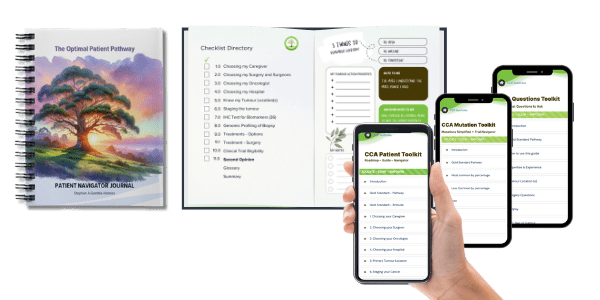
This free guide helps patients and caregivers organise tests, track results, prepare questions and navigate cholangiocarcinoma step by step.
Download your free journal here: