Beth Ivimey
A Journey Through Diagnosis
Introduction
by Steve Holmes
Beth Ivimey Cholangiocarcinoma Journey reflects a pattern many patients now face.
From time to time, the Foundation develops a video profile of a patient’s story while it is still unfolding. After discussion with Claire Holmes and with Jill Brown, our Director of Projects and Advocacy, we agreed that sharing the Beth Ivimey Cholangiocarcinoma Journey at this point is important for patients navigating similar terrain.
Her tumour was found incidentally. By the time it was clearly defined, it involved major vascular structures within the liver. Surgery was not possible. The focus shifted to systemic therapy, treatment delivered through the bloodstream rather than through removal of the tumour.
First-line chemotherapy and immunotherapy did not reduce the tumour.
At that point, the plan had to be reconsidered. Molecular profiling was undertaken. A mutation was identified. A matching clinical trial was initiated, and the tumour reduced. When resistance later developed and new secondary lesions appeared, treatment was reassessed, and another targeted therapy was accessed.
There was no single turning point. Response evolved step by step.
Beth continues to live with active treatment as it adjusts around her. That requires steadiness, experience and the willingness to revisit decisions when they need to change.
Below is her story, in her own words.
Understanding Beth Ivimey’s Cholangiocarcinoma Journey
I live in Sydney, in the inner west.
My husband and I met at Carols by Candlelight, by chance, many years ago. We lived in England for a time, then returned to Australia when I was offered a wonderful oncology nursing role.
I’m very fortunate. I have a wonderful family and three adult children who are the best thing since sliced bread.
Like everyone, I was busy.
Then I started to notice I was becoming breathless. I developed a persistent cough. I stopped walking Fergus because I was simply too tired.
We had already cut two weeks off a planned trip to Europe because I wasn’t well. We went to Venice. I had been looking forward to photographing the full moon from the bridges. But I couldn’t manage the bridges. I just couldn’t do it. That was deeply disappointing.
My diagnosis was a long time coming.
In March I saw my GP and was referred to a respiratory physician. I had a full respiratory work-up. There were no issues. Nothing explained the cough.
I then saw a cardiologist and underwent extensive investigations, finishing with a cardiac MRI.
That MRI showed something on my liver.
I had a dedicated liver scan on the Friday. That afternoon I received a call asking me to come in immediately.
The lesion was the size of a fist.
A large mass had been growing in my liver, pushing upwards. That explained the cough. That explained the breathlessness.
I saw the surgeon the next day.
The tumour involved two major veins. Surgery was not an option.
The plan was chemotherapy to try to shrink it.
I began chemotherapy at the end of January.
The plan was four cycles of chemotherapy combined with immunotherapy, followed by a scan, and then hopefully surgery.
The tumour did not move at all.
So the plan shifted to continuing chemotherapy and immunotherapy.
During that time, I was enrolled in Omico’s MOST trial. That is where a gene mutation was identified.
After completing chemotherapy and immunotherapy, I moved straight onto a clinical trial because the tumour had not responded.
Within two months on the trial drug, the tumour had shrunk by more than a third.
For the first time, there was something real to hold onto. We could make plans again. We could look forward to things.
There were side effects. I remained on that drug for a year. Then it broke through. New secondaries appeared.
I was very fortunate that my oncologist had access to another drug similar to the trial therapy. No one in Australia had received it yet.
I am still on that drug now.
When you are diagnosed, you have to learn how to live with it.
I did not have a dedicated nurse guiding me through every step.
I had an army of wonderful friends. But they were my friends, and they were carrying their own fear that someone they loved had cholangiocarcinoma.
The Foundation has experience. They understand this disease. They provide guidance and support when it is needed.
I have a wonderful life.
I look forward to many things. I have joy and happiness. I have my family and my friends.
And yes, I did go back to Venice.
There is a photo in the video of me standing there with absolute joy on my face.
I mastered those bridges.
And I did it because I was on the clinical trial.
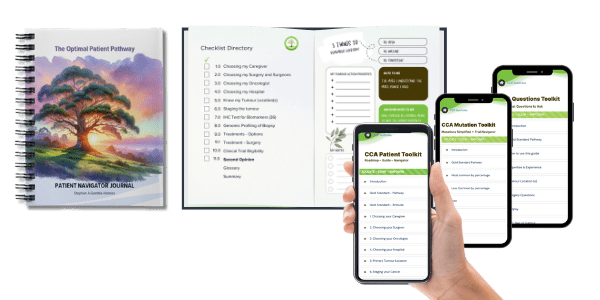
The Patient Navigator Journal
Cholangio.org builds the pathway.
The Patient Navigator Journal helps patients travel it.
This free guide helps patients and caregivers organise tests, track results, prepare questions and navigate cholangiocarcinoma step by step.
Download your free journal here:
Thankyou Beth for sharing your story of hope and perseverance. May you blessed with many more good days